BLUETTI Elite 300 Review (Ireland): We Boiled a Kettle, Ran the House and Charged It With the 350W Panel
Quick answer: The BLUETTI Elite 300 is a 3,014Wh, 2,400W LiFePO₄ power station that weighs 26.3kg. In our tests it boiled a full 3kW kettle using its power lifting mode, and a full charge is good for roughly 14 full boils. It kept our house essentials running through a simulated power cut and charged from the BLUETTI 350W panel at up to 169W on a November morning even with the panel in shade, and we saw it peak at 220W on a dull late-November morning. Overall, it’s an outstanding product and one of the best-sized portable units for Irish storm backup. The one thing we’d change: we’d love to be able to add an expansion battery for more capacity. Our score is 9.4/10.
Key findings from our Irish tests
- A full 1.7-litre kettle uses about 7% of a 3kWh battery, so the Elite 300 gives about 14 full boils (about 27 half-kettles) per charge.
- Six devices at once (two phones, a laptop, a Nintendo Switch, a projector and a drone) drew only 93–103W, which works out at roughly 23 hours from a full charge.
- A fridge-freezer runs for about two days on a full charge, longer with solar top-ups.
- The 350W panel pulled in up to 169W in shade in November and peaked at 220W on a dull late-November morning in Ireland.
- The 10ms UPS switchover kept our router and TV on without a blink when we cut the supply.
Journalists and bloggers: you are welcome to use these figures. Please credit and link to Irish Wind & Solar.
I’m Jeff from Irish Wind & Solar. I’ve spent years fitting rooftop solar and batteries around Ireland, so I’m not easily impressed by spec sheets. Over the last few weeks we unboxed the BLUETTI Elite 300, ran it in the van and the car, boiled a kettle on it, charged phones and laptops, switched off the house supply to see how it handled a power cut, and paired it with BLUETTI’s 350W foldable panel. Here’s what it can and can’t do, in plain numbers.
What is the BLUETTI Elite 300?
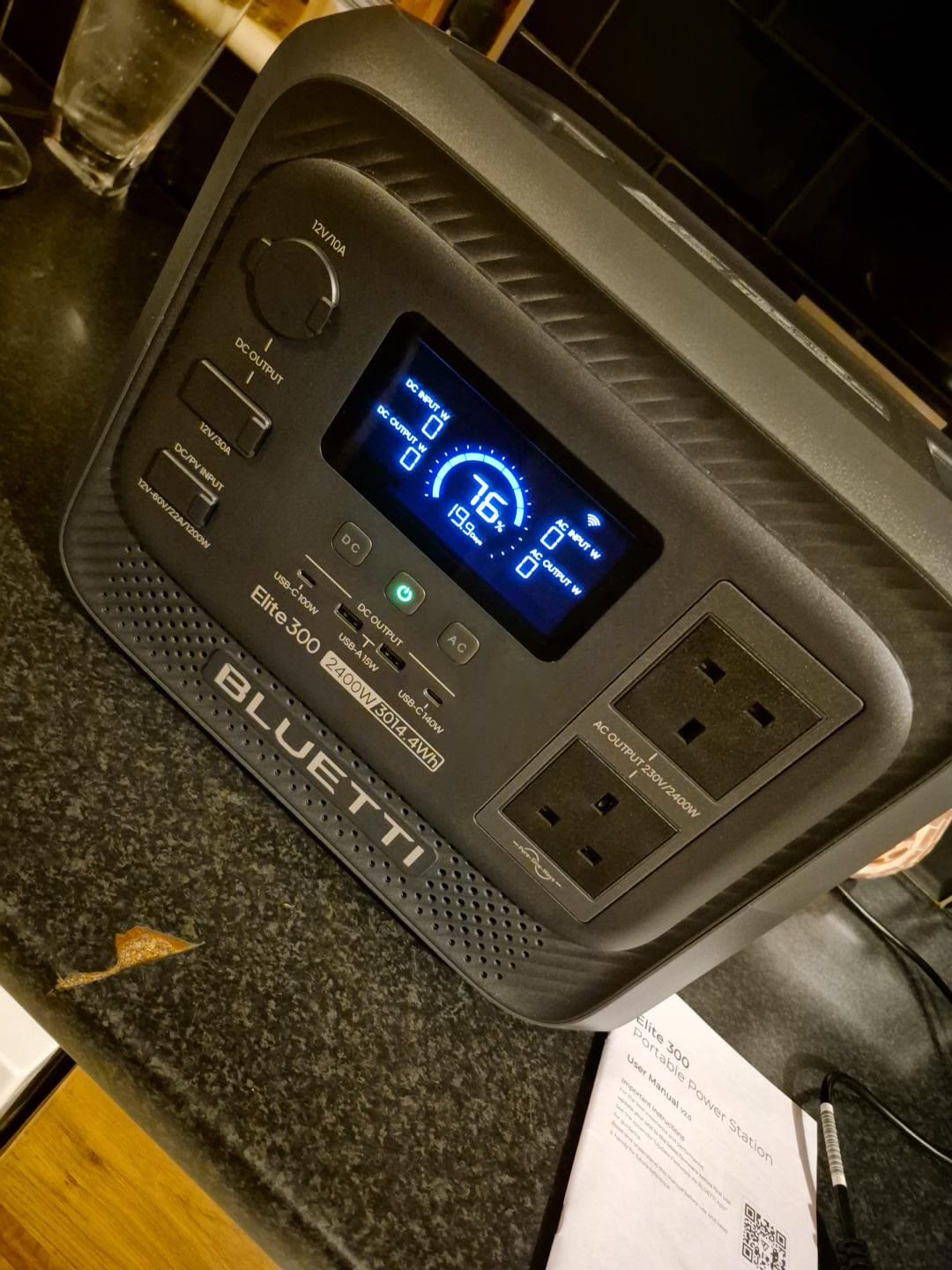
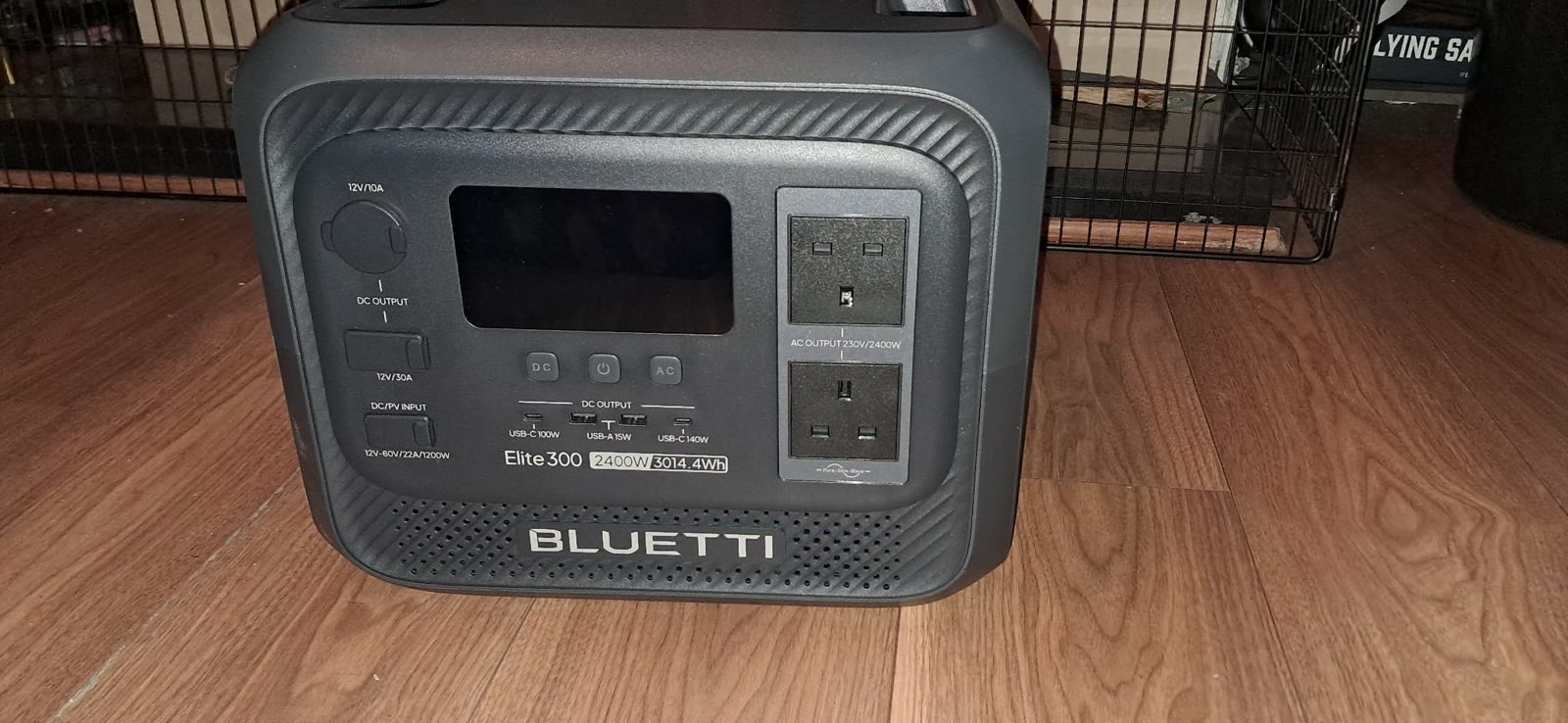
The Elite 300 is a portable power station: a lithium iron phosphate (LiFePO₄) battery, a 230V inverter, a solar charge controller and a mains charger in one box with handles. You charge it from a wall socket, from solar panels or from a car, and you plug normal appliances into it. BLUETTI calls it the smallest 3kWh power station on the market, a claim it says Frost & Sullivan has certified. Ours measures 366 × 305 × 298mm. That’s roughly the size of a large cool box, though a good deal heavier.
Free survey, grant check and a clear price with the grant already taken off.Check my savings
Irish buyers need the UK-plug version, which has UK three-pin sockets. BLUETTI’s EU store sells it as a separate listing, and the unit we tested is that version. You can check the full spec on BLUETTI’s own Elite 300 page, and we cover the wider range in our BLUETTI Ireland guide.
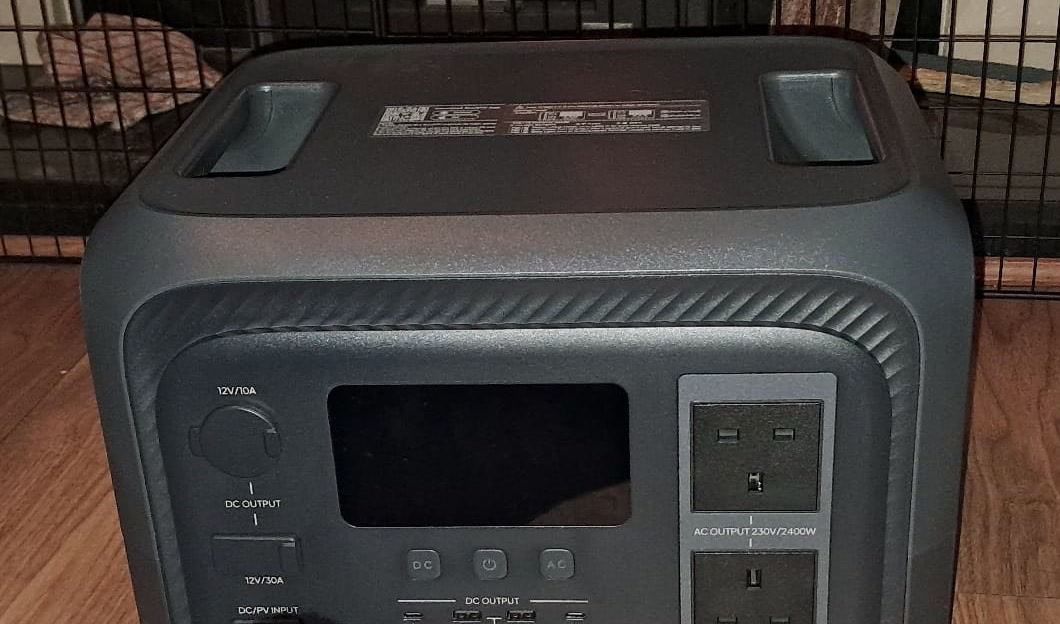
BLUETTI Elite 300 specifications
These are BLUETTI’s official figures from its EU product page, checked on 22 November 2026.
| Specification | BLUETTI Elite 300 |
|---|---|
| Battery capacity | 3,014.4Wh (314Ah) |
| Battery chemistry | LiFePO₄ (lithium iron phosphate) |
| Cycle life | 6,000+ cycles to 80% capacity |
| AC output (inverter) | 2,400W continuous, 230V, 50/60Hz |
| Surge / power lifting | 4,800W |
| AC output in bypass (while on mains) | 2,300W max |
| AC outlets | 2 × UK three-pin (Irish/UK version) |
| USB-C | 1 × 140W, 1 × 100W |
| USB-A | 2 × 15W |
| 12V DC | 1 × 12V/30A port, 1 × car (cigarette) socket 12V/10A, 120W max |
| AC charging input | 2,300W max, 10A, 230V |
| Solar / DC input | 1,200W max, 12–60V, 22A max (XT60 connector) |
| AC + solar together | 2,400W max |
| Solar charge time (at 1,200W) | about 4.1 hours to 100% |
| UPS switchover | ≤10ms |
| Pass-through charging | Yes |
| App | BLUETTI app over Wi-Fi and Bluetooth |
| Weight | 26.3kg |
| Dimensions (L × W × H) | 366 × 305 × 297.5mm |
| Charging temperature | 0°C to 40°C |
| Discharging temperature | −20°C to 40°C |
| Warranty | 5 years |
| In the box | Elite 300, 1.5m AC charging cable, grounding screw (M5×10mm), user manual |
| Price (BLUETTI EU, 22 Nov 2026) | €1,399 (normally €1,649), Black Friday price, 19–30 November |
How we tested it
We used the Elite 300 the way an Irish household or tradesperson would, and kept to tests anyone can repeat at home:
- Kettle test: a full 3kW kettle (rated 2,500–3,000W), cold water, boiled straight off the Elite 300.
- Device charging: phones and laptops over USB-C and from the AC sockets.
- Power-cut test: we switched off the supply at home and ran the essentials from the Elite 300.
- Solar test: the BLUETTI 350W panel set up outdoors in November, with the input read off the Elite 300’s display.
- On the road: carried in the back of the van and the car boot.
The kettle test: can the Elite 300 boil a 3kW kettle?
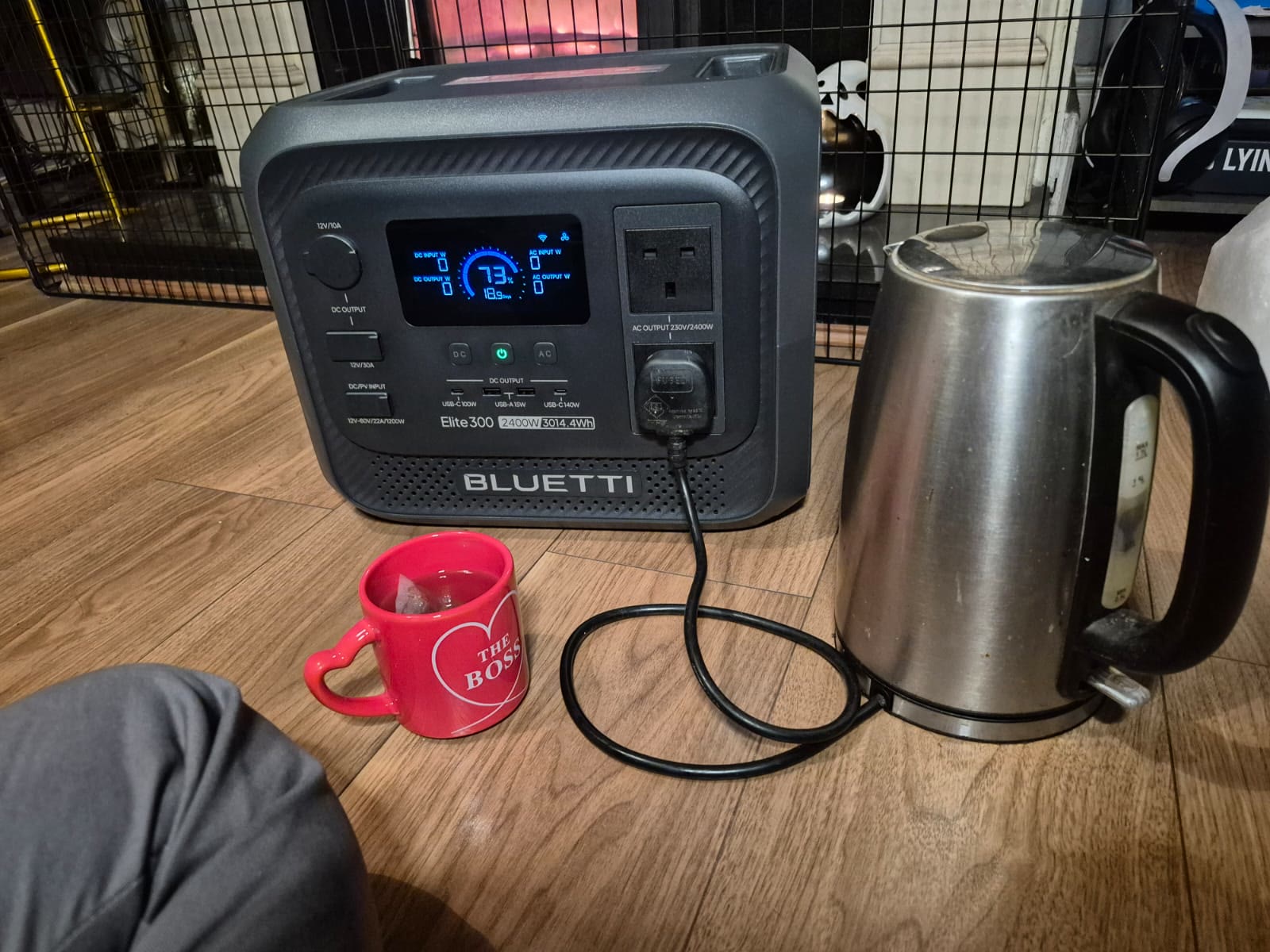
A kettle is about the hardest everyday job you can give a portable power station. Ours is an old Lidl SilverCrest SWKE 3100 D1, rated at 2,500–3,000W. That’s more than the Elite 300’s 2,400W continuous rating, so this was a real stress test. We filled it to its 1.7-litre maximum with cold water, plugged it into one of the Elite 300’s UK sockets and switched it on.
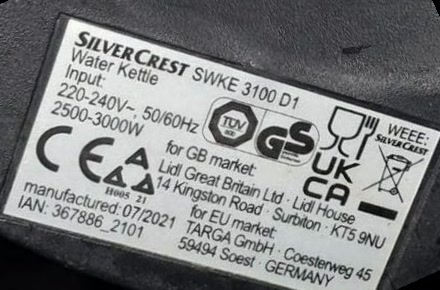
Result: the Elite 300 boiled the full kettle without tripping or complaining. It managed that thanks to BLUETTI’s power lifting mode (rated up to 4,800W). For heating appliances such as kettles, heaters and hair dryers, the Elite 300 lowers the output voltage, so an element rated above 2,400W still runs, drawing less power and taking a little longer. For an Irish home that’s a big deal, because most kettles sold here are 2.2–3kW.
How much battery does a full kettle use?
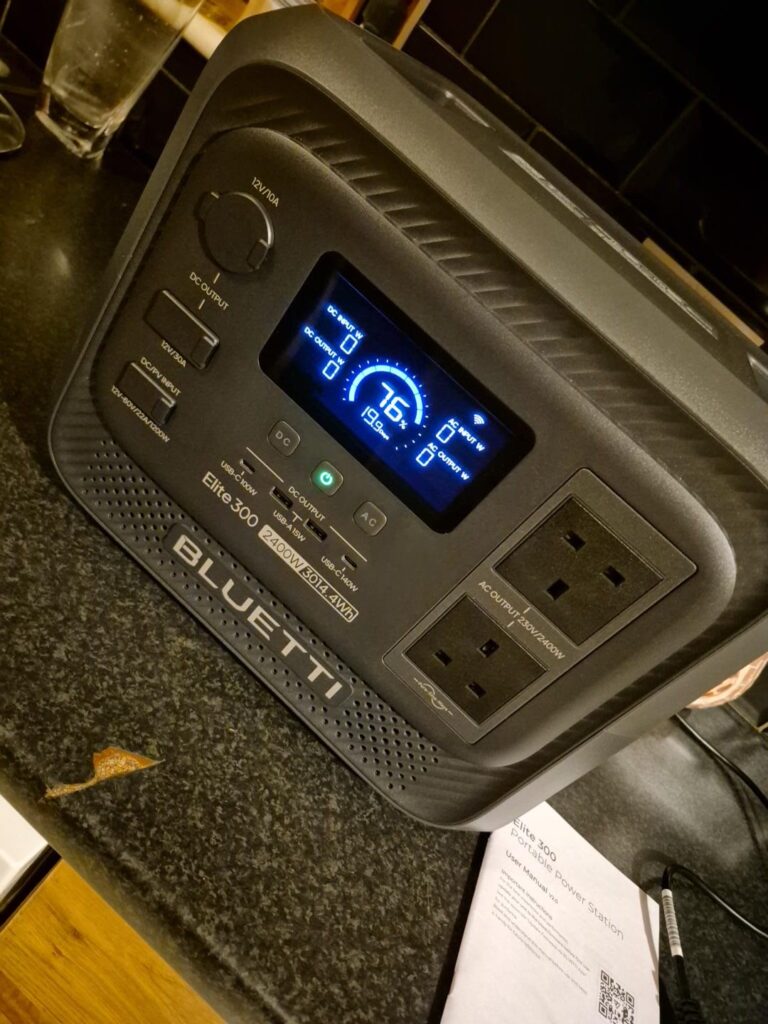
Straight after the boil, the screen read 73%, down from 76%. Battery gauges on any power station settle a little after a short, heavy load like a 3kW kettle, so rather than lean on that reading we’ve worked out exactly what a full 1.7-litre kettle takes from the battery:
| Step | Working | Result |
|---|---|---|
| Energy to heat 1.7 litres from tap-cold (about 10°C) to boiling | 1.7kg × 4.19kJ/kg°C × 90°C | about 178Wh into the water |
| Add kettle and inverter losses (about 80% overall) | 178Wh ÷ 0.8 | about 220Wh from the battery |
| Share of the Elite 300’s battery | 220Wh ÷ 3,014Wh | about 7% per full kettle |
| Full kettles from a full battery | 100% ÷ 7% | about 14 full boils |
| Half-full kettle (two or three mugs) | about 110Wh | about 3.5% each, roughly 27 boils |
That’s a strong result. Fourteen full kettles from one charge means four or five a day through a three-day power cut, with plenty of battery left for the fridge, Wi-Fi and lights. Boil only what you need for a cup or two and you’ll get closer to 27 boils. Hot tea in a storm, straight from the battery, is exactly what this unit is for.
Source: <a href="https://irishwind.ie/2026/11/22/bluetti-elite-300-review-ireland/">Irish Wind & Solar BLUETTI Elite 300 kettle test</a>Charging phones and laptops
We charged our phones and laptops from the Elite 300 over several days. In our power-cut test we charged two phones and a laptop at the same time as a Nintendo Switch, a drone and a projector, all for about 100W (see below). The two USB-C ports are the ones to use. The 140W port is enough to fast-charge most laptops without the laptop’s own power brick, and charging over USB-C skips the inverter, which wastes less energy than going through a 230V socket.
| Device | Typical battery | Approx. full charges from the Elite 300* |
|---|---|---|
| Smartphone | 15–20Wh | 130–170 |
| Tablet | 30–40Wh | 65–85 |
| Laptop | 50–100Wh | 25–50 |
| Cordless drill battery (18V 5Ah) | 90Wh | about 25–30 |
*Our estimates. They assume about 85% of the 3,014Wh reaches the device after charging losses, which vary from device to device.
Can the Elite 300 run your house in a power cut?
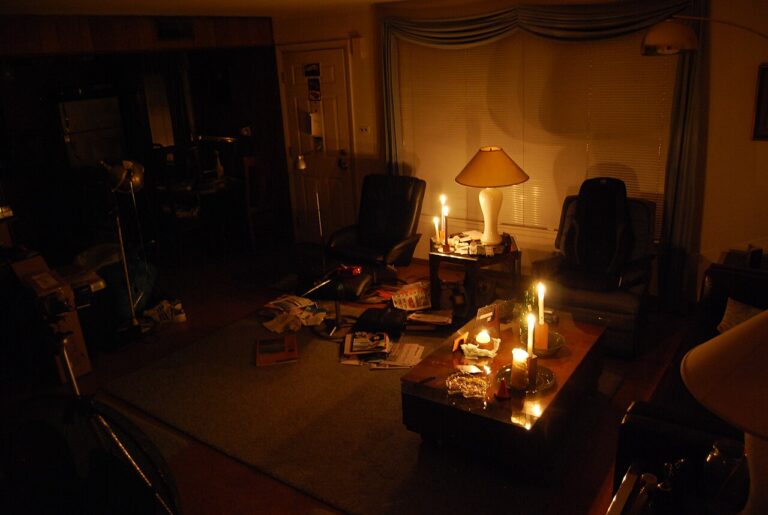
We simulated a power cut by switching off the supply at home and running everything from the Elite 300, using extension leads plugged into its two UK sockets. That’s the simple, safe way to do it, with no changes to your home wiring. Then we gave it the real family test, which I’d call the kid-proof test: everything a house full of people reaches for when the power goes, all plugged in at the same time.
The fridge: we also ran our fridge from the Elite 300 during the outage. It started up and kept running without any issue, so your food stays cold while the power is off. Going by the runtime figures below, a typical fridge-freezer can run for around two days on a full charge, and longer with a solar top-up.
The kid-proof test: six devices at once for about 100W
| Device | Connected to |
|---|---|
| 2 × smartphones | Charging |
| Laptop | Charging |
| Nintendo Switch | Charging |
| Mini projector | Running: films on the wall, no TV needed |
| DJI drone | Battery charging |
| Total load on the Elite 300 display | 93–103W |
Everything ran together without a hiccup, and the whole lot drew around 100W (93–103W as the devices charged). That’s about the same as a single old-style light bulb. Starting from 72%, the Elite 300’s own screen estimated 16.5 hours left at that load, which works out at roughly 23 hours from a full charge. In a real storm, that means the kids stay entertained, phones stay charged, and you can keep working, for a day and more, before you even think about a top-up from solar.
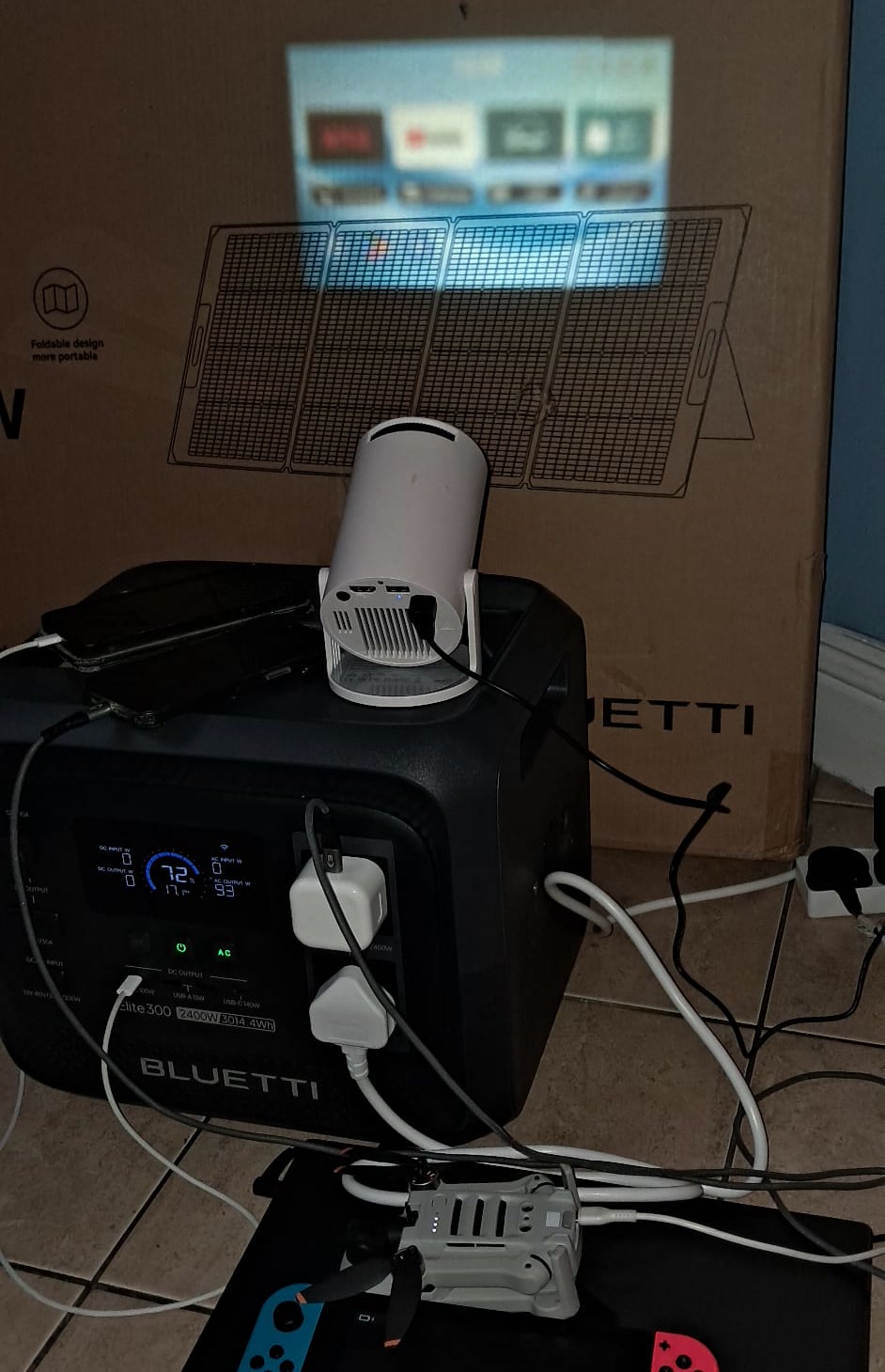
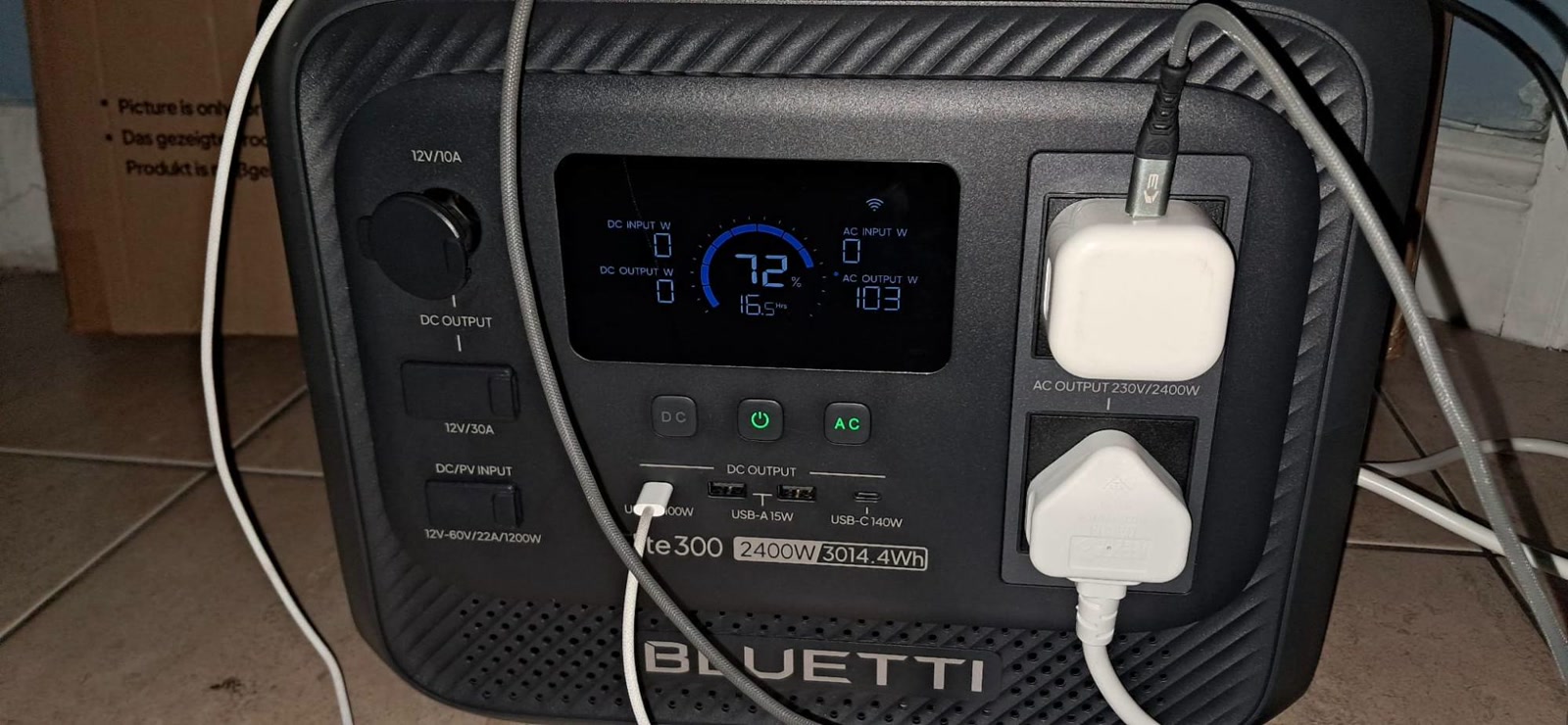
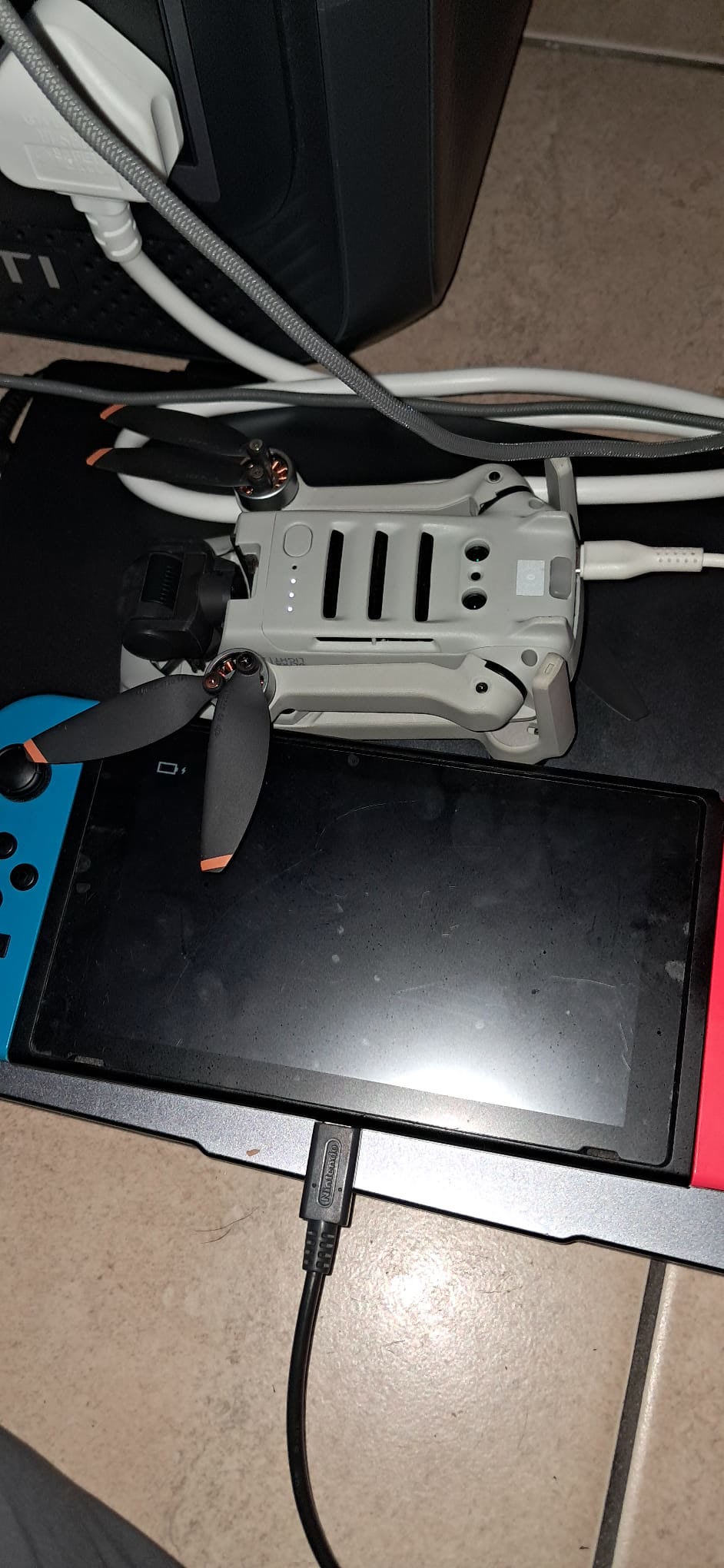
With 3kWh on board, the Elite 300 sits in a useful middle ground. It won’t run an Irish home as normal, because electric showers, immersions, ovens and storage heaters are far beyond any portable unit. It will keep the things that matter going through a typical storm outage: the fridge-freezer, Wi-Fi, lights, phones, the TV and, if wired safely, the controls and pump on an oil or gas boiler.
How long will it run things? (estimates)
| Appliance | Typical draw | Approx. runtime on a full Elite 300* |
|---|---|---|
| Wi-Fi router | 10W | about 11 days |
| 5 LED bulbs | 40W | about 65 hours |
| Fridge-freezer (A-rated, cycling) | average 40–60W (1–1.4kWh/day) | about 2 days |
| TV (50-inch LED) | 80W | about 34 hours |
| Oil/gas boiler controls and pump | 80–150W while firing | 1–2 days, depending on how often it fires |
| Microwave, 5 minutes at 1,000W | about 100Wh per use | about 27 uses |
| Kettle, 3kW, full (power lifting) | about 220Wh per full boil | about 14 full boils |
| 2kW plug-in heater | 2,000W | about 1 hour 20 minutes. Not a good use of the battery |
| Fridge-freezer + router + lights + phones | about 1.5kWh/day | about 1.8 days, longer with solar top-ups |
*Our estimates. They assume about 2,700Wh usable at the sockets after inverter losses. Real appliances vary, so check the rating plate on yours.
LED Christmas lights are a light load on any power station too. We worked out their running costs in how much Christmas lights cost to run in Ireland.
<p>What can a 3kWh power station run in an Irish power cut? See the <a href="https://irishwind.ie/2026/11/22/bluetti-elite-300-review-ireland/#runtime-table">Elite 300 runtime table from Irish Wind & Solar</a>.</p>That lines up with the Government’s Be Winter Ready advice to be ready to cope for 72 hours without power. Keep an eye on Met Éireann weather warnings and read ESB Networks’ advice on preparing for a power cut. Our 72-hour power cut survival guide covers the rest of that plan.
Safety: never backfeed your house. Don’t connect a power station to your home wiring through a socket with a male-to-male lead. It’s dangerous for you and for ESB Networks crews working on the line. To power circuits like the boiler or lighting directly, have a registered electrician fit a proper changeover or isolator switch. See why an isolator switch matters for battery backup. Otherwise, plug appliances straight into the Elite 300 or into a good extension lead from it.
The 10ms UPS function
If you leave the Elite 300 plugged into the mains with your router, PC or alarm panel plugged into it, it passes mains power straight through (up to 2,300W) and switches to battery in 10ms or less if the power drops. BLUETTI says this is fast enough that most electronics won’t notice, so your Wi-Fi stays up and a desktop PC doesn’t reboot. In our test it did exactly that: when we switched off the supply, the router and the TV stayed on without a blink. For anyone working from home in rural Ireland, where short dips and trips are common in winter, this is the most useful feature on the unit.
If you have a home solar battery, it helps to know whether it will run your house in a power cut without a power station at all. We explain that in will your solar battery work in a power cut?
Charging the Elite 300: mains, solar and car
| Charging method | Max input | Approx. 0–100% time |
|---|---|---|
| Mains (wall socket) | 2,300W | Very fast in our use. BLUETTI’s EU page doesn’t list an exact AC charge time, but at 2,300W the maths gives about 1.5 hours from empty. |
| Mains + solar together | 2,400W | about 1.3–1.5 hours (our calculation) |
| Solar, at the full 1,200W | 1,200W | about 4.1 hours (BLUETTI figure; needs around 4 × 350W panels in full sun) |
| Solar, one 350W panel, optimal conditions (facing full sun) | about 280–300W | about 11–13 hours of good sun, so 2–3 days |
| Solar, one 350W panel, our November test (in shade) | up to 169W measured | Enough to cover a day’s phones, router and lights, even out of direct sun |
| Car 12V socket (Car Charging Cable, €49) | about 100W (BLUETTI doesn’t list a figure) | roughly 30 hours of driving. Only useful for top-ups |
| Alternator + solar via BLUETTI Charger 2 (accessory) | up to 1,200W | about 3 hours (BLUETTI says 13× faster than the car socket) |
The adjustable charge rate is useful in practice. Turbo gets it full quickly before a storm warning, and a slower, quieter rate suits overnight charging in a bedroom or tent.
The BLUETTI 350W solar panel (PV350)
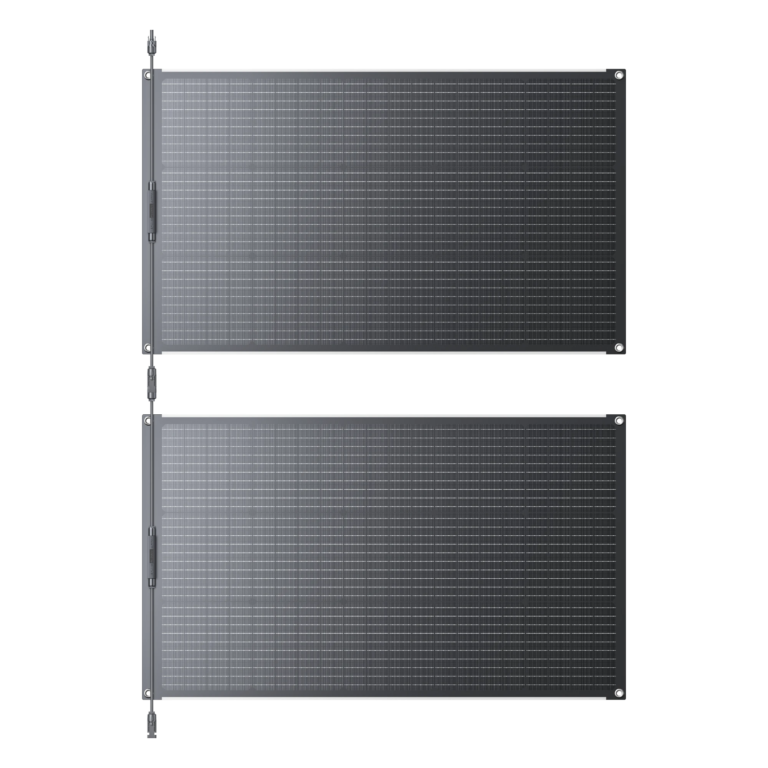
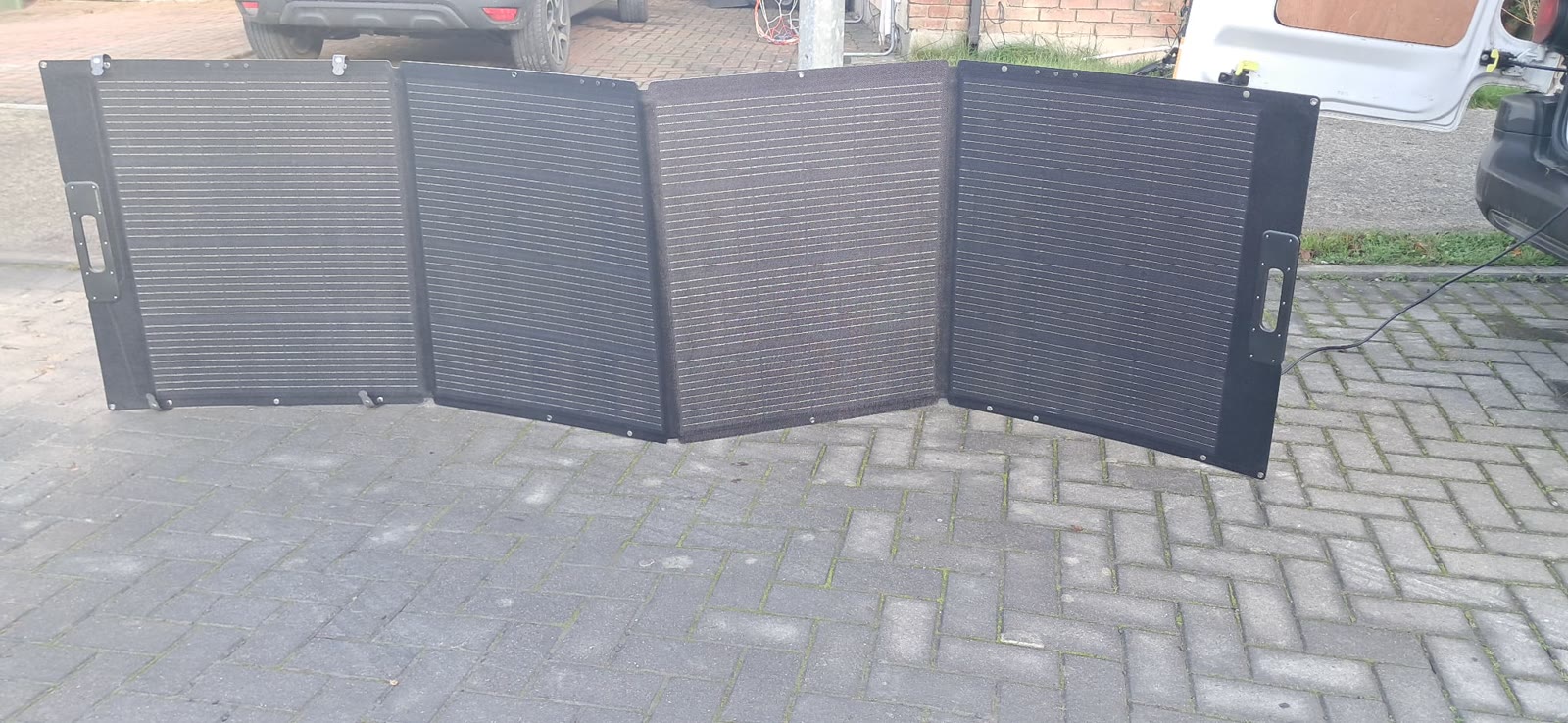
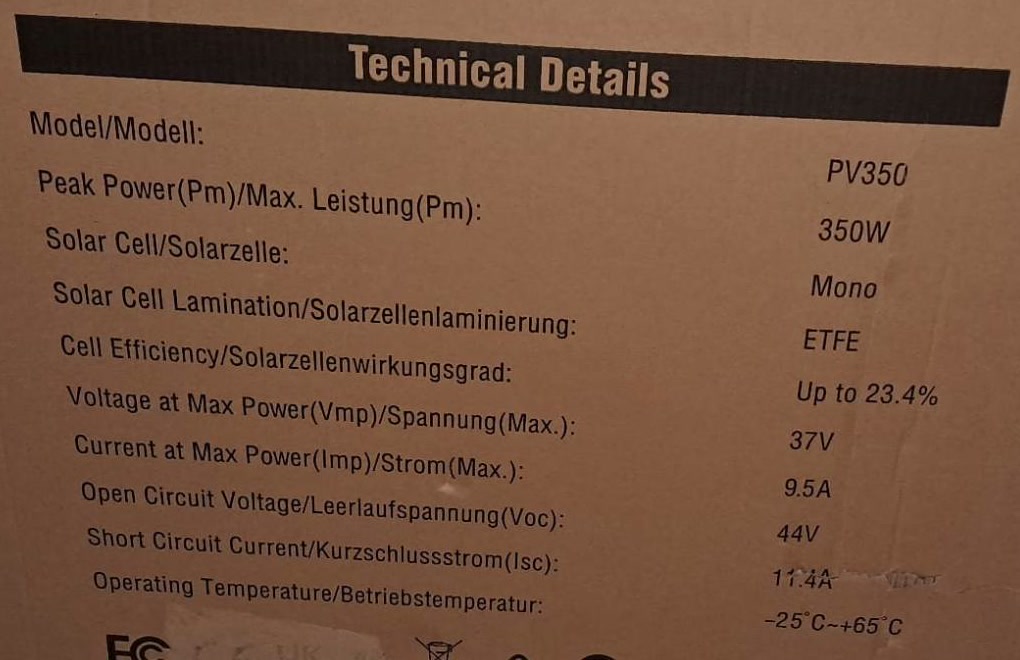
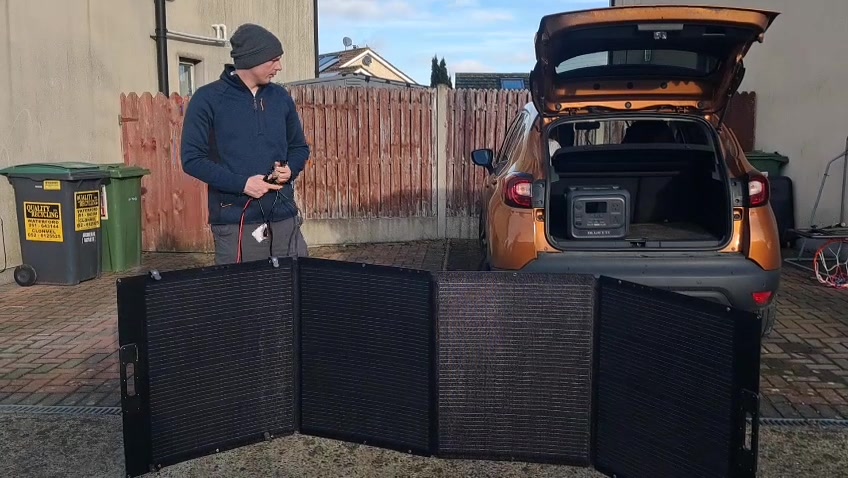
We paired the Elite 300 with BLUETTI’s 350W foldable panel, sold on BLUETTI’s EU store as the “BLUETTI 350W Solar Panel” (often called the PV350). It folds into a large briefcase-sized slab with a carry handle and opens out to four panels with an adjustable kickstand.
| BLUETTI 350W panel | Figure |
|---|---|
| Model | PV350 |
| Peak power (Pm) | 350W |
| Cells | Monocrystalline, up to 23.4% cell efficiency |
| Voltage at max power (Vmp) | 37V |
| Current at max power (Imp) | 9.5A |
| Open-circuit voltage (Voc) | 44V |
| Short-circuit current (Isc) | 11.4A |
| Operating temperature | −25°C to +65°C |
| Connectors | MC4 |
| Weather rating | IP67 |
| Surface | ETFE lamination over reinforced fibreglass |
| Kickstand angle | 35°–55°, adjustable |
| Warranty | 1 year + 1 year (BLUETTI EU) |
| Price (BLUETTI EU, 22 Nov 2026) | €449 (normally €599). Elite 300 + 350W bundle €1,699 (normally €2,199) |
Figures from the technical details printed on our PV350’s box, plus BLUETTI’s EU product page for the IP rating, kickstand, warranty and price.
Connecting the panel
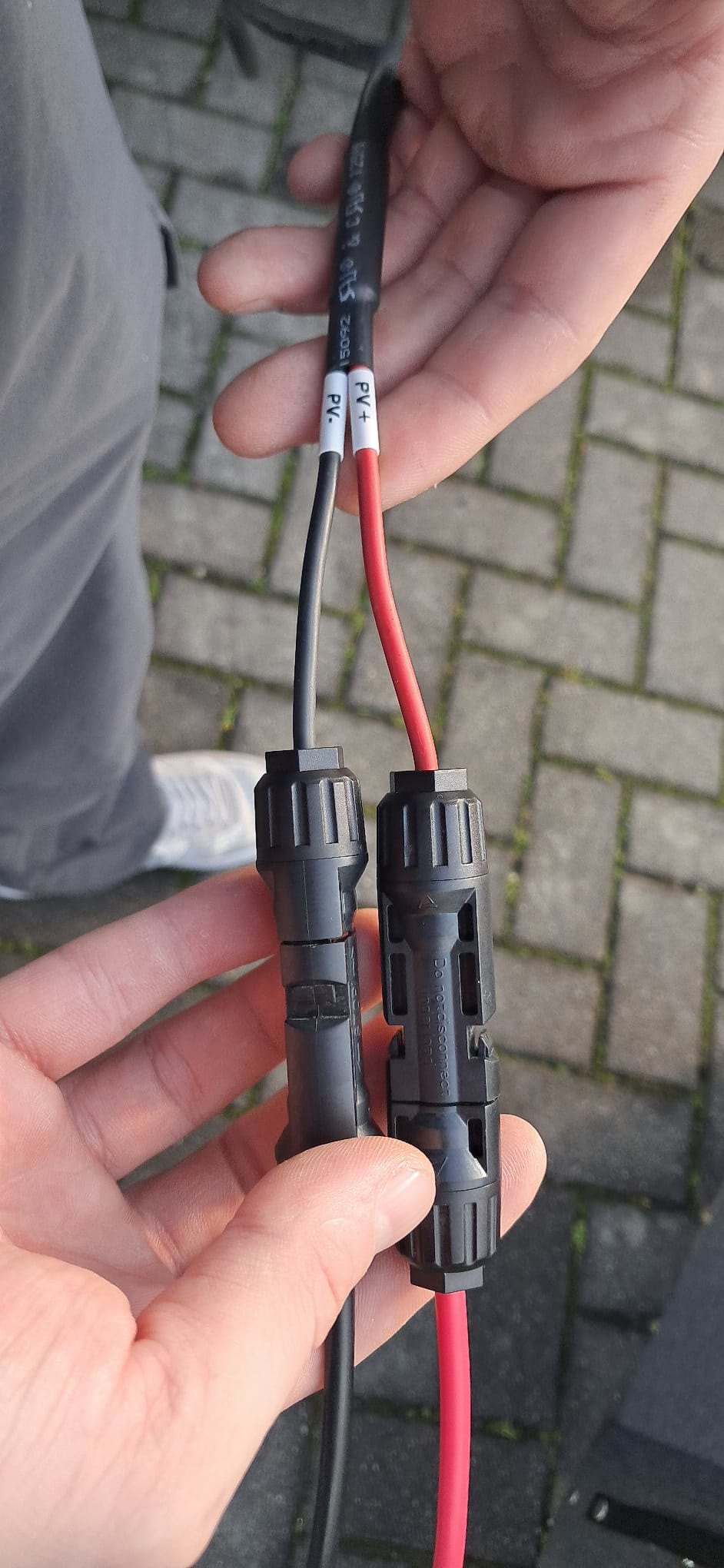
The panel has standard MC4 plugs, and the Elite 300 takes solar through an XT60 socket marked DC/PV input (12–60V, 22A, 1,200W). An MC4-to-XT60 cable joins the two. The MC4 plugs only fit one way, positive to positive and negative to negative, and they click and lock.
What it actually produced in Irish weather
On a cold November morning, with the sun low in the sky and the panel sitting in shade, we propped it on the driveway and read the input off the Elite 300’s screen. It still pulled in up to 169W, holding steady around 150–160W. For a panel out of direct sun in an Irish November, that’s an impressive result, and it shows how well the PV350 and the Elite 300’s charge controller make use of diffuse light.
And on a dull morning at the end of November, we saw it peak at 220W. That shows what this panel can do when the light comes through.
In optimal conditions, expect around 280–300W. With the panel facing the sun square-on on a bright, cool, clear day, the PV350 should deliver close to its full rating. Around 280–300W of its 350W is what a good folding panel realistically gives in real-world sun, because panels lose a little output to heat and cable losses. At that rate, one PV350 puts back roughly 10% of the Elite 300’s battery every hour.
Realistic daily solar yield in Ireland (one 350W panel)
| Month | Typical energy per day* | What that covers |
|---|---|---|
| December–January | 0.2–0.35kWh | Router and phones for a day, or one or two full kettles |
| March / October | 0.6–0.9kWh | Most of a fridge-freezer’s daily use |
| May–July | 1.2–1.6kWh | Fridge-freezer, router and lights, or 40–50% of the Elite 300 |
*Our estimates for a panel angled at the sun and moved two or three times a day in the south and midlands, based on typical Irish solar figures from the EU’s PVGIS tool. The north-west will be a little lower and cloudy spells much lower.
The takeaway: one 350W panel won’t refill a 3kWh battery in an Irish winter. It will stretch the battery a good way in a long outage, and from spring to autumn it can keep a campervan or off-grid cabin going. For faster solar charging, the Elite 300 takes up to 1,200W, so three or four panels is the sensible ceiling. Wire extra panels in parallel, not series: each PV350 has an open-circuit voltage of 44V, so two in series (88V) would go over the Elite 300’s 60V input limit. In parallel, the voltage stays at 44V and the Elite 300 limits the current to its 22A maximum. Check BLUETTI’s manual before connecting more than one. For more on winter output, see how solar panels perform in an Irish winter. We compare other portable options in our foldable solar panels guide.
Portability: is 26.3kg portable?
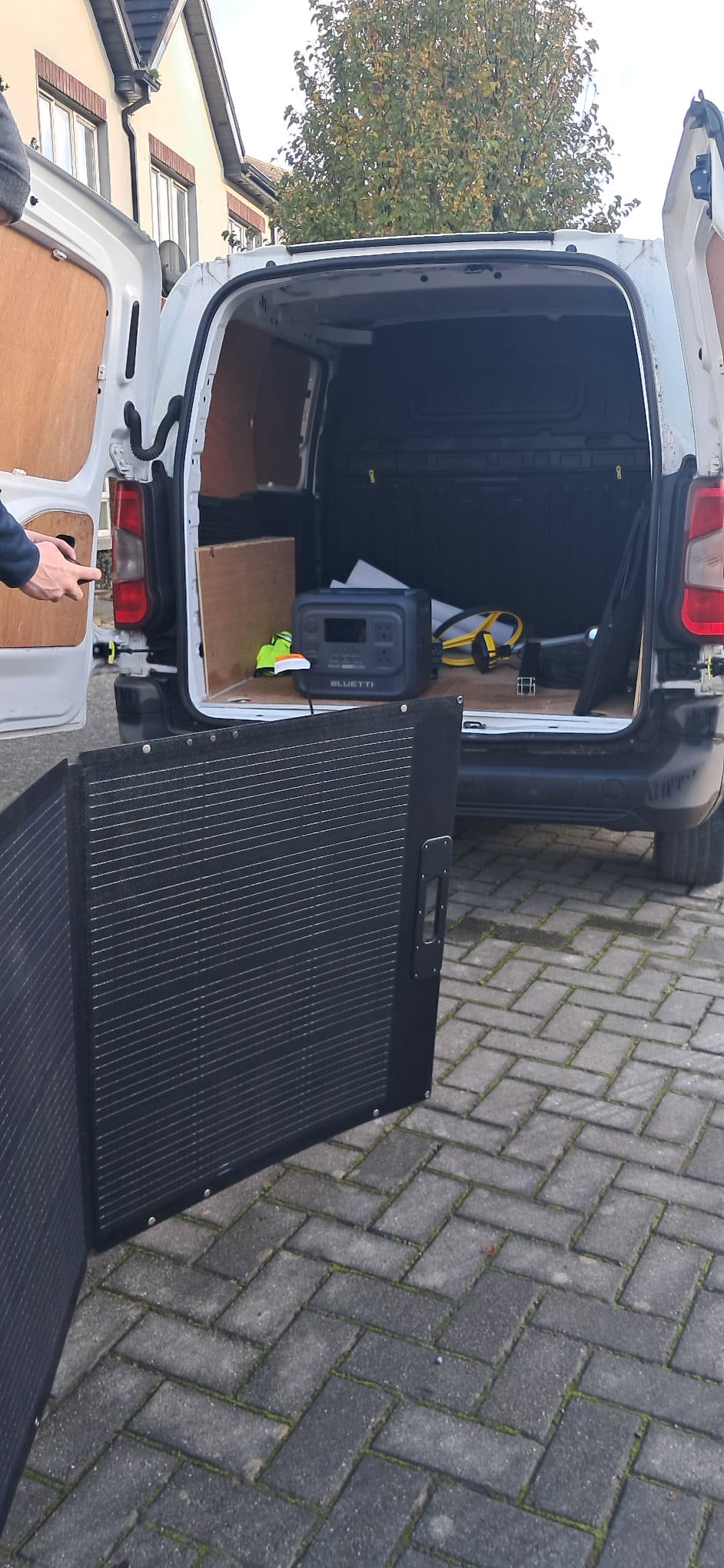
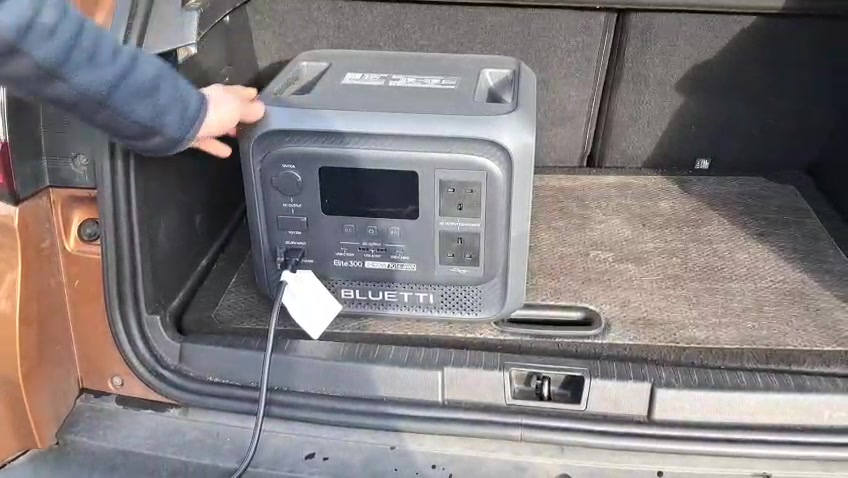
Yes, and the weight was less of an issue than we expected. The two moulded handles on top make it an easy lift for one adult, whether it’s from the hall to the kitchen or from the boot to a pitch. For 3kWh it’s very compact, and in the van and the car boot it sits flat and stable. If you’ll be moving it around a lot, or you have a bad back, BLUETTI also sells a trolley. You can find the Elite 300 in our energy-saving shop.
Ports and outputs
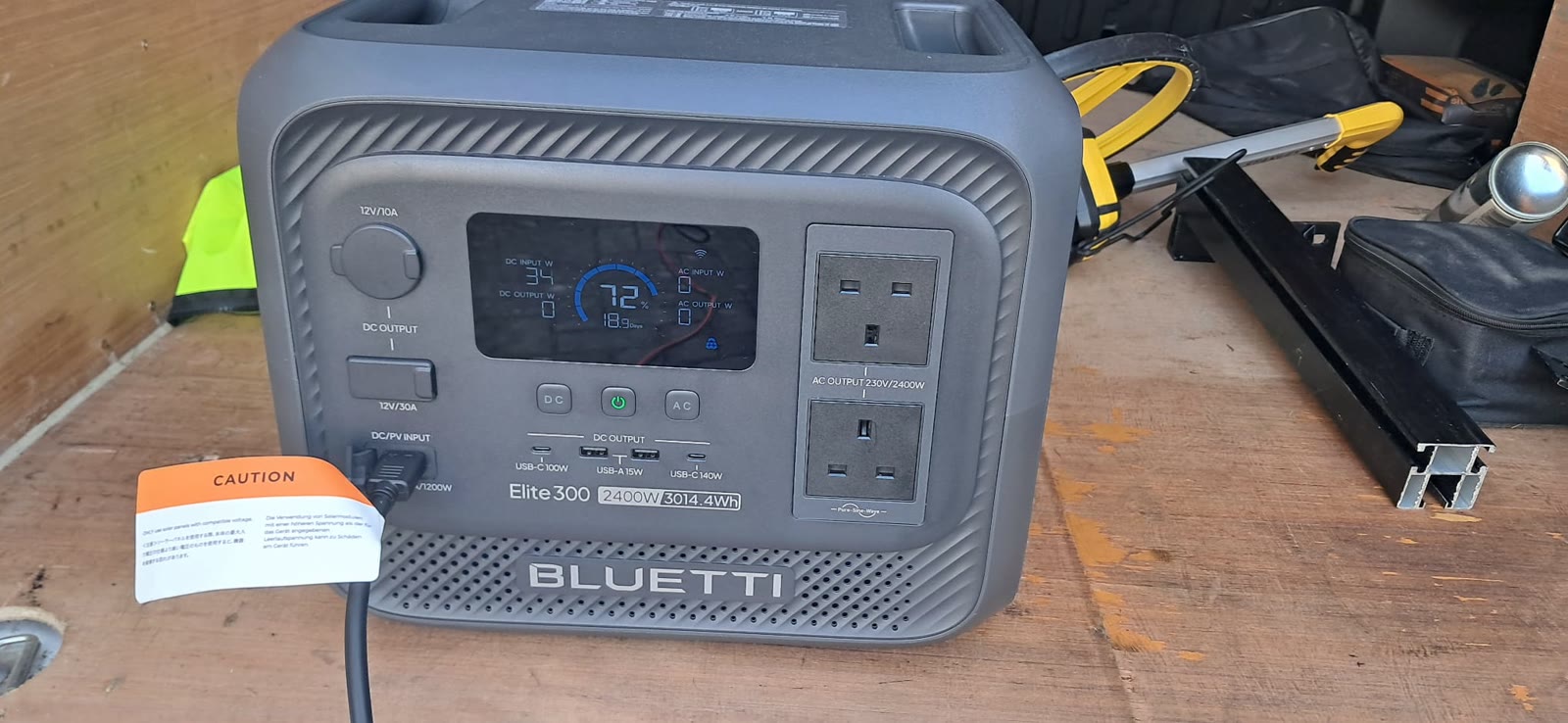
The front panel is laid out logically. The 12V outputs and the DC/PV input are on the left, the screen and USB ports are in the middle, and the two UK sockets are on the right. The 12V/30A port is the stand-out for caravans and campervans: it runs a 12V compressor fridge, water pump and lights directly, without converting up to 230V and back. The main limitation is that there are only two AC sockets. In a power cut you’ll want a good-quality extension lead, kept well within the 2,400W total.
The BLUETTI app: how easy is it to use?
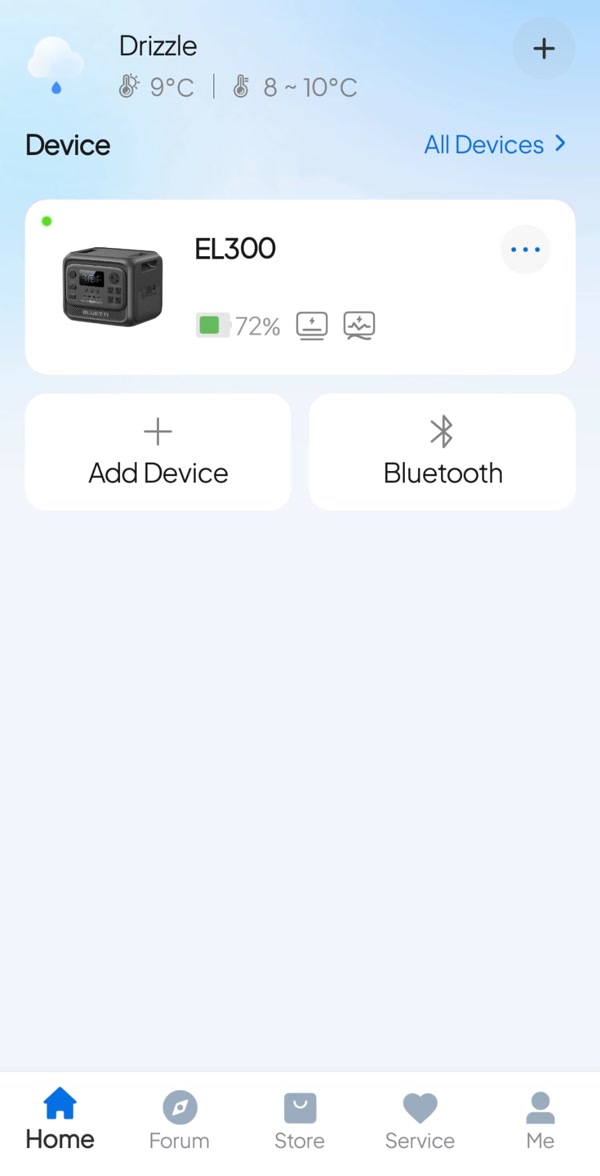
I’ll be honest: I expected the app to be an afterthought. It turned out to be one of my favourite things about the Elite 300. It’s genuinely user friendly. I had it paired and showing live figures within a couple of minutes, without opening the manual.
Setting it up
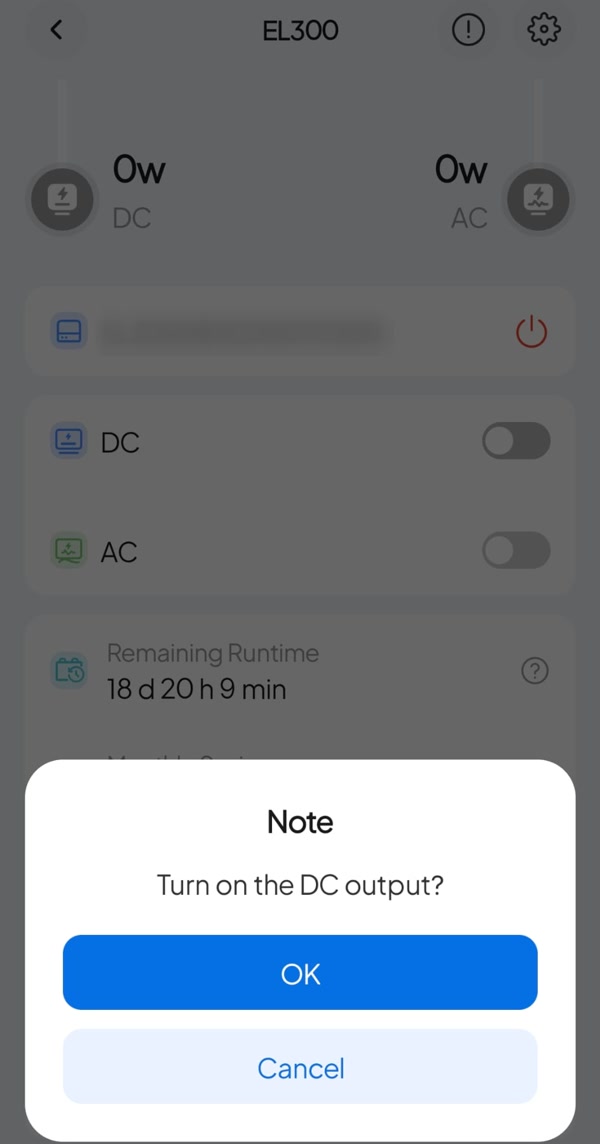
Download the BLUETTI app, create an account, tap Add Device and the app finds the Elite 300 over Bluetooth. From there you can connect it to your home Wi-Fi so you can check it from anywhere. The whole process took a few minutes. On first connection the app offered a firmware update. It’s optional, so you can skip it, but we installed it and it went through without any trouble.
Seeing exactly where your energy is coming from
This is where the app really earns its place. The main screen shows live watts on each side: what’s coming in (mains or solar) and what’s going out through the AC sockets and DC ports, alongside the battery percentage and the remaining runtime at the current load. When we had the 350W panel out on the driveway, I could watch the solar input rise and fall as clouds crossed the sun, without walking out to the unit. In a power cut, you can see at a glance what your fridge or router is drawing and how long you have left, which takes the guesswork out of rationing the battery.
Bluetooth and Wi-Fi connectivity
The Bluetooth connection is excellent. It found the Elite 300 straight away and held the connection reliably around the house. That matters, because Bluetooth works with no internet at all, which is exactly what you have in a storm when the broadband is down. On Wi-Fi you can also check and control it when you’re away from home, for example from work, or to keep an eye on a unit left running in a van or a shed.
What you can control from the app
| Feature | What it does | Why it’s useful |
|---|---|---|
| Live energy monitor | Watts in from mains or solar, watts out on AC and DC, battery % | See exactly where your energy is coming from and going to |
| Remaining runtime | Time left at the current load | Plan your power use in an outage |
| AC and DC on/off switches | Turn the 230V sockets and the 12V/USB outputs on or off, with a confirm step | Switch off outputs you don’t need to save power, without touching the unit |
| Charging mode | Choose a faster (Turbo) or quieter, gentler charge rate | Fast top-up before a storm, or silent overnight charging |
| Remote wake and schedules | Wake the unit remotely and set outputs to turn on or off automatically (BLUETTI feature) | Automate lights, pumps or heaters in a van, cabin or shed |
| Settings and updates | Device settings and firmware updates | New features and fixes arrive through the app |
| Forum, Store and Service tabs | BLUETTI’s user community, shop and support in one place | Help and advice is a tap away |
The BLUETTI community: more like a family than a business
What really got me interested was the community behind BLUETTI. The app has a Forum tab built in, where owners share their setups, ask questions and help each other out: campervan builds, off-grid cabins, home backup during storms, solar tips. It feels more like a family than a business. People are genuinely enthusiastic, and you’re never on your own if you get stuck. For someone buying their first power station, that kind of support is worth a lot. Alongside it, the Service tab puts BLUETTI’s own support in the same app. There’s a lot in there. The Forum carries BLUETTI news, lets owners co-create and give feedback on products, and is full of people sharing what works for them. On top of that there’s a dedicated support and services page, so if you need BLUETTI itself, help is in the same app.
Can you expand the Elite 300’s battery?
No, not as of right now. There’s no expansion battery for the Elite 300, so the 3kWh is what you get. That’s my one real wish for this unit. If you think you’ll want 5–10kWh later, look at a larger BLUETTI home system or a fixed home solar battery instead. For most people buying for storms and camping, 3kWh is already the right size. If you are weighing up a fixed system, our guide to winter battery storage in Ireland explains what a home battery can and can’t do in the dark months.
Our scores
| Category | Score | Why |
|---|---|---|
| Capacity and output | 9.8 | 3kWh and 2,400W (4,800W surge) handle a kettle, microwave or power tools easily |
| Mains charging | 9.5 | Up to 2,300W input, with a quiet mode when speed doesn’t matter |
| Solar charging (with the 350W panel) | 9.0 | 1,200W input is generous. One panel is slow in an Irish winter, but that’s true of any panel |
| Home backup / UPS | 9.5 | 10ms switchover and LiFePO₄ longevity. We’d love an expansion battery option |
| Ports | 9.0 | Excellent 12V/30A and 140W USB-C. Two AC sockets is tight for home use |
| Portability | 9.0 | Very compact for 3kWh; the two handles make 26.3kg easy to manage |
| App and screen | 9.5 | Very easy to use: live energy flow, strong Bluetooth plus Wi-Fi, and a friendly built-in community forum |
| Build and warranty | 9.8 | Solid, well-finished case. 6,000-cycle LiFePO₄ and a 5-year warranty |
| Value | 9.5 | €1,399 on offer (€1,649 normally) for 3kWh LiFePO₄ is strong value |
9.4 / 10 Overall: BLUETTI Elite 300 with the 350W panel
A powerful, well-built 3kWh station that suits Irish storm backup, vans and camping. Overall, it’s an outstanding product. Our only wish is more battery capacity through an expansion battery.
Pros and cons
Pros
- 3,014Wh is enough for 1–2 days of household essentials
- 2,400W continuous and 4,800W surge run kettles, microwaves and tools
- Boiled a full 3kW kettle thanks to power lifting
- 10ms UPS keeps Wi-Fi and PCs running through power cuts
- LiFePO₄, 6,000+ cycles and a 5-year warranty
- Fast 2,300W mains charging and up to 1,200W solar input
- 12V/30A port for campervan fridges and pumps
- 140W USB-C charges laptops without a brick
- Very user-friendly app: see exactly where your energy comes from, with excellent Bluetooth connectivity
- A genuine, friendly BLUETTI owners’ community built into the app
- Very compact for 3kWh, and the two handles make it easy to move
- Irish-friendly UK-plug version with three-pin sockets
- Ran six devices at once (phones, laptop, Switch, projector, drone) for about 100W
- Everything needed was in the box: we were up and running straight away
Cons
- I wish it had more battery capacity: no expansion battery is listed on BLUETTI’s EU page
- Only two AC sockets
- Can’t be charged below 0°C (fine indoors, watch it in a frosty van)
- One 350W panel is slow to recharge 3kWh in an Irish winter
Who is the Elite 300 for in Ireland?
| Use | Good fit? | Our view |
|---|---|---|
| Storm and power-cut backup at home | Yes, very good | Keeps the fridge-freezer, Wi-Fi, lights, phones and boiler controls (wired safely) going for 1–2 days, longer with solar. See our guide to EirGrid alerts and winter blackouts. |
| Working from home in rural areas | Yes | The 10ms UPS stops router and PC drop-outs during short trips |
| Campervans and caravans | Yes, very good | 12V/30A port, 1,200W solar input and alternator charging via Charger 2. Add a flexible solar panel on the roof |
| Camping and festivals | Yes, with a car nearby | Plenty of power for a weekend, but you won’t carry it far from the car |
| Trades and site work | Yes | 2,400W runs most 230V tools and chargers in a van with no site power |
| Off-grid cabin or shed | Yes, in summer | Pair it with 2–3 panels. In winter you’ll need another source |
| Whole-house backup (showers, immersion, heating) | No | Too small. Look at a fixed home battery with backup and a proper isolator |
| Medical equipment | Possibly, with care | Check the device’s wattage with its supplier and register with your electricity supplier as a vulnerable customer |
Verdict
The Elite 300 is a serious piece of kit. It boiled a full 3kW kettle, beyond its 2,400W rating, thanks to power lifting, and a full charge covers about 14 full boils. It kept the house essentials going when we cut the supply and charged happily from the 350W panel, pulling around 160W even in shade in November. My only wish is more battery capacity, and the option to add an expansion battery would make it close to perfect. If you rely on solar in winter, you’ll also want more than one panel. For an Irish household that wants to ride out a storm outage with the fridge, Wi-Fi and lights on, or a van owner who wants proper 230V power on the road, it’s one of the best-sized units you can buy, and our recommended product for that job.
Be ready before the next storm. Talk to Irish Wind & Solar on 083 480 0023 about the BLUETTI Elite 300, the 350W panel and safe backup power for your home.
FAQ
Can the BLUETTI Elite 300 boil a kettle, and how many times?
A full 1.7-litre kettle takes about 220Wh, roughly 7% of the battery, so a full charge gives about 14 full boils, or around 27 if you only half-fill it. It ran our 3kW kettle using power lifting.
Can the Elite 300 run a fridge-freezer?
Yes. A typical fridge-freezer uses 1–1.4kWh a day, so the Elite 300 will run one on its own for about two days, longer with solar top-ups.
How long does the Elite 300 take to charge?
From the mains, it accepts up to 2,300W, so roughly 1.5 hours. From solar at the full 1,200W, about 4.1 hours (BLUETTI figure). A single 350W panel takes 2–3 sunny summer days, or over a week in mid-winter.
Can I use the Elite 300 as a UPS?
Yes. Left plugged into the mains, it passes power through (up to 2,300W) and switches to battery in 10ms or less if the power fails.
Does the Elite 300 work with Irish sockets?
Buy the UK-plug version. It has UK three-pin sockets, which are the same as the plugs used in Ireland.
Can I expand the Elite 300 with an extra battery?
BLUETTI’s EU product page doesn’t list an expansion battery for the Elite 300, so plan on 3kWh. If you need more, look at a larger home system.
Will the 350W panel work in Irish weather?
Yes. Even in shade on a November morning it pulled in up to 169W, we saw it peak at 220W on a dull late-November morning, and in optimal conditions, with the panel facing full sun, expect around 280–300W. In summer, expect 1.2–1.6kWh a day from one panel. In mid-winter, 0.2–0.35kWh.
Sources: gov.ie, Be Winter Ready. ESB Networks, Be Prepared. BLUETTI EU, Elite 300 product page and tech specs (bluettipower.eu, checked 22 Nov 2026). BLUETTI EU, Elite 300 UK-plug listing. BLUETTI EU, 350W Solar Panel page. EU Joint Research Centre PVGIS for Irish solar yields. All test results are Irish Wind & Solar’s own, November 2026.