Solar Panels for Apartment Blocks in Ireland (2026): OMC Approval, Planning & Grants
Apartment owners and renters have been locked out of solar for years. Not any more. Here’s what’s coming, what you can do right now, and how to get your block in first.
Quick answer: Yes – apartment blocks in Ireland can install solar panels, and most rooftop systems don’t need planning permission. The roof usually belongs to the Owners’ Management Company (OMC), so the OMC has to approve and normally applies for the SEAI grant (up to €1,800). The best-value setup for most blocks is a shared rooftop system that powers the common areas – lifts, hall lighting, pumps and car-park lights – which lowers everyone’s service charge.
☀️ Plug-in balcony solar: where things stand
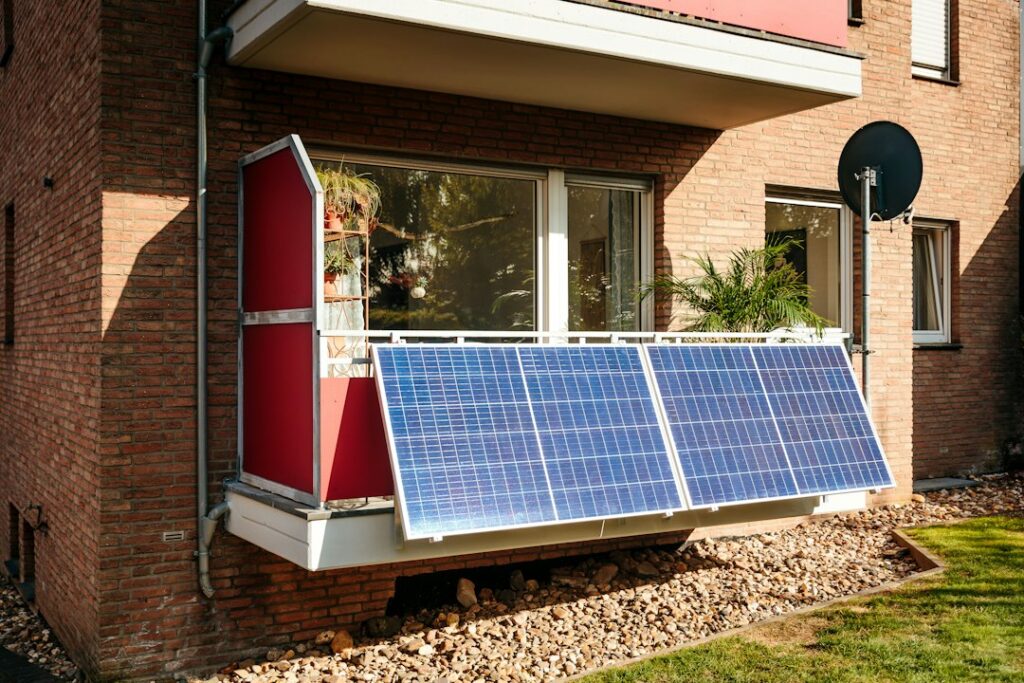
Small plug-in balcony panels aren’t legal to plug into a wall socket in Ireland yet, but they’re on the way. In July 2026 the Energy Minister told the Dáil that ESB Networks supports plug-in solar or battery devices up to 800W with a simple registration process, and an ESB Networks-led working group is drafting the rules. No date or grant has been announced. See our plug-in and balcony solar guide for what you can do today, including BLUETTI backup power for apartments. Read more below ↓
Answer a few questions to see which SEAI grant you could get and roughly what solar would save you.Check my grant
Can apartment blocks in Ireland get solar panels?
Absolutely. Solar panels for apartment blocks in Ireland are no longer a rare pilot project. Rooftop solar now makes up close to 1 GW of Ireland’s solar capacity, and more than 155,000 homes and properties have panels. Apartment dwellers have mostly been left out so far – not because the technology doesn’t work, but because of shared ownership, paperwork and who pays.
The good news: flat apartment roofs are often better for solar than house roofs. There’s no shading from chimneys, panels can be tilted to face south, and a single installation can serve a whole building. And solar works in Irish weather – panels run on daylight, not heat, and actually perform well in the cold. As a rule of thumb, every 1 kWp of panels in Ireland produces roughly 850–900 kWh of electricity a year.
Do apartment blocks need planning permission for solar panels?
In most cases, no. Since October 2022, a dedicated planning exemption – Class 60 of S.I. No. 493/2022 – covers solar panels on the roofs of apartment buildings. If you follow its conditions, the system counts as “exempted development” and you don’t need to apply for planning permission.
The key Class 60 conditions in plain English
- Roof only. The exemption covers panels on the roof of the apartment building (or the roof of an ancillary building in its grounds). Wall-mounted and free-standing systems are not covered.
- Setbacks and height limits. Panels must be kept back from the roof edge and must not rise above set heights – your installer designs around these.
- Mostly for the building. The electricity must be “primarily” used on site – the law defines this as more than 50%.
- No dazzling. If panels cause hazardous glint or glare, the exemption is lost.
- Solar Safeguarding Zones. Near airports and some other sensitive sites, the total panel area is capped at 300 m² and the council must be told in writing within 4 weeks of work starting.
Who has to say yes? The Owners’ Management Company
This is where most apartment solar projects stall – so it’s worth getting right. In a typical Irish development, each owner owns their own apartment, but the roof, walls, wiring and common areas belong to the Owners’ Management Company under the Multi-Unit Developments Act 2011. That means:
- An individual owner usually can’t put their own panels on the shared roof without the OMC’s written permission.
- The OMC board may be able to approve the project itself, or it may need a vote at the AGM – check the company’s constitution and house rules.
- The OMC (or its property management agent, with written authority) is the body that applies for the SEAI grant.
How to win the vote
Owners say yes when the numbers are simple. Bring three things to the meeting: a roof survey and system design, a clear cost per apartment, and the yearly saving on the service charge. Answer the usual worries up front – roof warranty, insurance, maintenance and what happens if the roof needs repairs later. A good installer will help you prepare this pack for free.
4 ways to use solar on an apartment block
The right setup depends on how the building is wired and what the owners want. Here’s how the options compare:
| Option | How it works | Best for | Watch out for |
|---|---|---|---|
| 1. Common-area solar (most popular) | One rooftop system wired to the landlord/common supply. Powers lifts, corridor and car-park lighting, door entry, pumps, ventilation and EV chargers. | Most blocks. One meter, one install, savings shared through the service charge. | Small blocks with very low common-area usage – size the system to the demand. |
| 2. Individual arrays on the shared roof | The roof is split up; each participating apartment gets its own panels and inverter, cabled to its own meter. | Low-rise blocks with short cable runs and enough roof space. | Needs a licence from the OMC for each roof section, plus longer cable runs and more inverters. |
| 3. Shared system with sub-metering | One larger system whose output is split between apartments using metering and an agreed formula. | New-builds and larger developments planned this way from day one. | More complex billing; needs clear rules on who manages readings and faults. |
| 4. Plug-in balcony solar (rules pending) | Up to 800W of panels on a balcony, plugged into a normal socket in one apartment. | Renters and owners who can’t get roof access. | Not yet legal to plug into a socket; rules being drafted. Smaller output than rooftop solar. |
Our advice: start with common-area solar. It’s the cheapest to install, easiest to get approved and every owner benefits equally. Common loads like lifts, emergency lighting and ventilation run every day, so most of the solar power is used on site – which is where the real savings are. Any surplus is sold back to your electricity supplier under the Clean Export Guarantee.
The SEAI solar grant for apartment blocks
Yes, apartment blocks can get the SEAI Solar PV grant. The scheme is open to homeowners, private landlords, Owners’ Management Companies and Approved Housing Bodies. For 2026 the grant is:
| System size | SEAI grant |
|---|---|
| 2 kWp | €1,400 (€700 per kWp) |
| 3 kWp | €1,600 |
| 4 kWp and above | €1,800 (maximum) |
Grant rules that catch apartment blocks out
- Apply BEFORE any work starts. You need a grant approval in place first – start early and you lose the grant.
- Building age. The cut-off date was widened in October 2026 so many newer buildings now qualify – check the current date on the SEAI website.
- One grant per MPRN. No previous solar PV funding is allowed at that meter point.
- OMC applications are paper-based. They’re created by the OMC or its property management agency (with written authority), using forms you request from SEAI.
- Registered installer. The work must be done by a company on the SEAI register, and you have 8 months from approval to finish.
Remember, the €1,800 grant is a contribution, not the full cost. On a larger block the grant covers a smaller share – the bigger win is the yearly saving on common-area electricity, plus 0% VAT on qualifying supply-and-install solar for homes.
Costs, savings and payback for an apartment block
Every building is different, so treat this as an illustration, not a quote. Here’s a typical example of common-area solar on a mid-sized block:
| Example: 20-apartment block, flat roof | Estimate |
|---|---|
| System size | 10 kWp (around 23 panels) |
| Yearly generation | about 8,500–9,000 kWh |
| Typical uses | Lift, corridor and car-park lighting, pumps, door entry, EV chargers |
| Cost per apartment | Split 20 ways – usually a fraction of what one house system costs |
| Result | Lower common-area bills, lower service charge and a better BER for the building |
Figures are indicative only and depend on roof size, orientation, access, scaffolding, common-area usage and your electricity tariff. Contact us for a free site-specific estimate.
What drives the cost up or down
- Roof access and safety – edge protection, cranes or scaffolding on tall buildings.
- Roof type – flat roofs usually need ballasted frames that don’t pierce the membrane.
- Cable runs – the distance from the roof down to the landlord meter room.
- Structural check – an engineer may need to confirm the roof can carry the load.
- Battery or not – adds cost, but stores more of your own power for evenings.
Who benefits?
Owners get lower service charges and a more valuable, greener building. Landlords get a better BER for their units – which matters more and more for rental rules and buyers. Tenants get a building that’s cheaper to run, which helps keep charges down.
Should an apartment block add a battery?
Many common-area loads (corridor lights, car-park lights, emergency lighting) run in the evening and overnight – exactly when the sun’s gone. A battery stores the midday surplus so the building uses it after dark instead of selling it cheaply to the grid. For apartment blocks we recommend the Sigenergy SigenStor system: it combines the inverter, battery and EV charging in one compact unit, is easy to expand later, and is ideal for a plant room or meter room where space is tight. We also install Tesla, Solis, GoodWe and SAJ.
Step-by-step: getting solar on your apartment block
- Check the basics. Who owns the roof? Is the building a protected structure? Does it meet the SEAI build-date cut-off?
- Get a free roof survey. We look at roof space, shading, structure, access and your common-area electricity bills.
- Get a design and a clear proposal. System size, cost per apartment, expected savings and payback.
- OMC approval. Board decision or AGM vote, plus written sign-off and any licence terms.
- Apply for the SEAI grant. The OMC or its managing agent applies and waits for approval – no work before this.
- Confirm planning. Check the design meets Class 60, and notify the council if you’re in a Solar Safeguarding Zone.
- Installation. Usually just a few days on a typical block, with minimal disruption to residents.
- Grid paperwork and switch-on. ESB Networks notification, smart meter for export, and sign up for the Clean Export Guarantee.
- Claim the grant and monitor. Track generation and savings from your phone and report them at the AGM.
Get a free solar survey for your apartment block
Irish Wind & Solar has installed over 2,000 systems across Ireland in 6 years. We’ll survey your roof, prepare a clear proposal your owners can vote on, and handle the SEAI grant paperwork.
Contact usPlug-in balcony solar: where the rules stand in Ireland
If your OMC won’t approve rooftop solar, or you’re renting, plug-in balcony solar is the one to watch. It’s one or two panels clipped to a balcony rail, with a small inverter that plugs straight into a normal wall socket. Your apartment uses the power first, so your bill drops from day one.
Is plug-in solar legal in Ireland?
Not yet, but it’s being worked on. At the moment every grid-connected solar system in Ireland has to be fitted by a registered electrician and notified to ESB Networks. That’s changing:
- Government backing: Energy Minister Darragh O’Brien has said plug-in solar could be a “game changer” for apartments and multi-unit developments, and has asked ESB Networks to draft the rules.
- ESB Networks on board: in July 2026 the Minister told the Dáil that ESB Networks supports small plug-in solar or battery devices up to 800W, with a simple registration process, as long as they meet safety and product standards.
- Neighbours have done it: plug-in solar up to 800W became legal in Great Britain on 27 August 2026 (Northern Ireland isn’t covered yet), and Germany has more than 1.3 million registered plug-in systems.
- Timeline: an ESB Networks-led working group first met in June 2026 and was due to report to the Minister in September. No rules or start date have been published yet. We’ll update this guide the moment it’s official.
Will there be a grant for plug-in solar?
No plug-in solar grant has been announced. There’s political pressure for one (the Green Party, for example, has called for a balcony solar grant), but nothing official yet. Kits are far cheaper than a rooftop system, so the payback can be reasonable even without a grant once they’re allowed.
Is my balcony suitable?
- South-facing is best; east or west works for part of the day; north-facing isn’t worth it.
- Permission: renters will need the landlord’s OK, and owners should check OMC house rules on balconies and façades.
- Buy certified: when the rules land, only buy kits that meet the Irish standard – don’t plug in a cheap import before then.
Solar PPAs for apartment blocks: solar with no upfront cost
If your owners’ management company (OMC) likes the idea of solar but can’t fund it from the sinking fund, a solar Power Purchase Agreement (PPA) is worth a look. A third party pays for, installs and maintains the system on your roof, and the OMC simply buys the electricity it uses, at an agreed rate below normal grid prices.
- No upfront cost: the funder owns the system and takes care of maintenance.
- Two agreements: usually a roof lease plus the PPA itself, so the funder has the right to keep the panels on the roof.
- Long terms: commercial solar PPAs in Ireland commonly run 10 to 15 years.
- End of term: typical options are to extend, buy the system or have it removed. Check this before signing.
Solar PPAs in Ireland are mostly offered to businesses today, and an apartment block needs to be big enough to interest a funder. The OMC’s legal advisers should review the lease and PPA, including what happens if the roof needs repairs. For smaller blocks, a grant-funded system the OMC owns outright is often better value over 25 years. We can price both options for you.
Frequently asked questions
When will plug-in balcony solar be legal in Ireland?
No date has been set. ESB Networks supports plug-in devices up to 800W with a simple registration process, and a working group led by ESB Networks is drafting the rules. Until they’re published, plugging a solar panel into a wall socket isn’t allowed. A portable power station charged by a folding panel is a legal option today.
Can I put solar panels on my apartment roof myself?
Not without permission. The roof is almost always a common area owned by the Owners’ Management Company. You’d need written approval – usually a licence for part of the roof – covering access, insurance, maintenance and removal.
Do apartment blocks need planning permission for solar panels?
Usually not. Rooftop solar on apartment buildings is exempted development under Class 60 of S.I. No. 493/2022, as long as you meet its conditions. Protected structures, Architectural Conservation Areas, wall-mounted panels and free-standing systems are the main exceptions.
Can a management company get the SEAI solar grant?
Yes. Owners’ Management Companies can apply, or their property management agency can apply with written authority. The grant is up to €1,800 for a 4 kWp or larger system, and approval must be in place before work starts.
How much electricity will solar panels produce on an Irish apartment block?
Roughly 850–900 kWh per year for every 1 kWp installed on a well-positioned roof. A 10 kWp system would produce around 8,500–9,000 kWh a year.
What happens to the solar power the building doesn’t use?
It’s exported to the grid, and your electricity supplier pays for it under the Clean Export Guarantee. Adding a battery lets the building keep more of its own power for the evening.
Will solar panels damage the roof?
Not when installed properly. On flat roofs, ballasted frames sit on the roof without drilling through the membrane. A good installer will check the roof’s condition and warranty before starting.
What if the roof needs repairs later?
Panels can be removed and refitted. Agree up front in the OMC licence or contract who pays for this so there are no surprises.
Are solar panels worth it for a small apartment block?
Usually yes, if the system is sized to match common-area demand. Blocks with a lift, EV chargers or round-the-clock lighting see the best returns. A free survey will tell you the real payback for your building.
Information correct as of November 2026. Grant amounts and rules can change – always confirm current terms on the SEAI website before you commit.
Photo: Yuma Solar on Unsplash