
Solar for Factories and Warehouses in Ireland: What a 50–100kWp System Costs and Saves
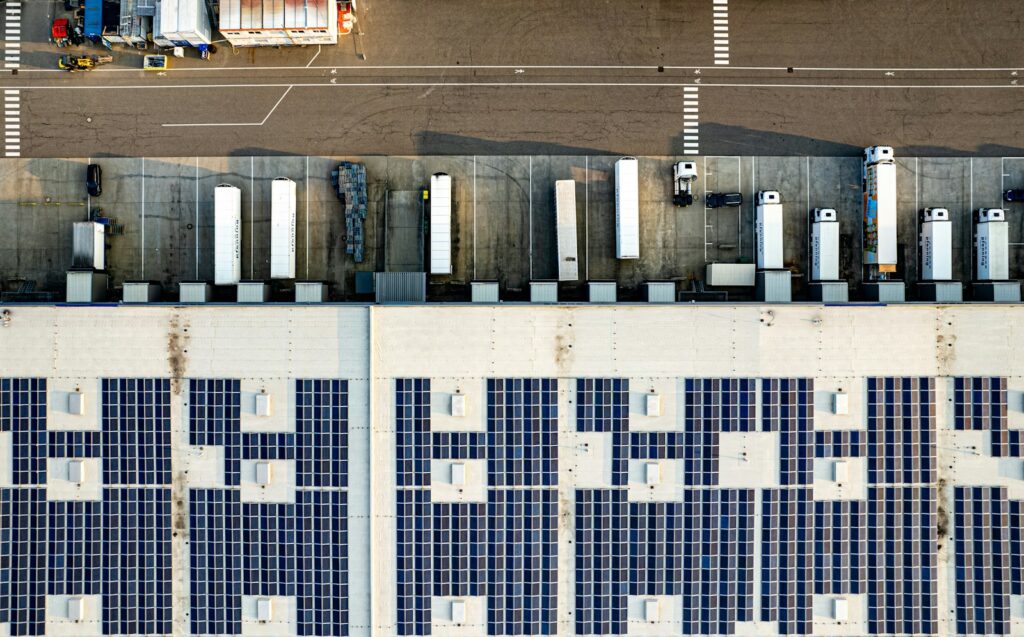
A factory or warehouse roof is one of the best places in Ireland to put solar panels. It is big, it is usually unshaded, and the building underneath tends to use electricity all day, every weekday. That last point matters more than anything else, because the cheapest unit of electricity is the one you make and use yourself.
We install commercial systems across all 26 counties from our base in Waterford, including an 80kWp array on a warehouse roof in Thurles. This guide covers what a 50 to 100kWp system involves for an Irish business, what the SEAI grant is worth right now, and how to think about savings and payback without relying on wishful numbers.
Why the 50 to 100kWp range suits so many Irish sites
For a typical light industrial unit, distribution warehouse or food production facility, 50 to 100kWp is often the sweet spot. It is large enough to make a real dent in daytime consumption, but small enough that most of what the panels generate gets used on site rather than exported.
As a rough guide, a 100kWp array needs somewhere in the region of 500 to 600 square metres of usable roof, depending on panel size, layout and the setbacks needed around roof edges and rooflights. A structural check of the roof is part of every survey we do.
Book a free energy audit (worth €2,000). We review your bills, size the system and work out the SEAI business grant (about 45% until July 2027) and ACA tax savings.Book my free energy audit
How much electricity will it generate?
Ireland gets more usable sunlight than most people expect. Modelling from the European Commission’s PVGIS tool puts annual yield for a well-oriented system at roughly 780 kWh per kWp in the north-west up to around 980 kWh per kWp in Cork, with a national average a little over 900. Flat roofs, east-west layouts and shading all pull that figure down, so we model every roof individually.
| System size | Approx. annual generation (850–950 kWh/kWp) | Typical roof area needed |
|---|---|---|
| 50kWp | 42,500 – 47,500 kWh | 250 – 300 m² |
| 80kWp | 68,000 – 76,000 kWh | 400 – 480 m² |
| 100kWp | 85,000 – 95,000 kWh | 500 – 600 m² |
These are planning estimates, not guarantees. Your actual figure depends on orientation, pitch, shading and the panels chosen.
The SEAI grant is bigger than it was
The SEAI Non-Domestic Microgen grant is open to businesses, farms, schools, public bodies, community centres and non-profits. For new applications made between 6 October 2026 and 6 July 2027, SEAI has increased the support rate to an effective 45%, as part of the National Energy Affordability Taskforce measures. The maximum grant is now €325,200 for systems up to 1,000kWp. Full details are on the SEAI Commercial Solar PV page.
The grant is calculated in bands. The first 6kWp attracts €4,800, each kWp from 7 to 20 attracts €600, and each kWp from 21 to 200 attracts €400. On our reading of SEAI’s published bands, that works out approximately as follows:
| System size | Approx. grant under current bands | Notes |
|---|---|---|
| 50kWp | €25,200 | Capped at 45% of the invoiced cost |
| 80kWp | €37,200 | Capped at 45% of the invoiced cost |
| 100kWp | €45,200 | Capped at 45% of the invoiced cost |
SEAI pays the lower of the amount in your letter of offer or 45% of the final invoice. Two rules catch people out. First, you must not start work until you have a letter of offer, and offers are valid for eight months. Second, the higher rate only applies to new applications, so an older offer cannot be topped up. Our SEAI grants guide walks through the process step by step.
Tax treatment: what your accountant will want to know
Photovoltaic systems fall under the Accelerated Capital Allowance scheme for energy-efficient equipment, which lets a trading business write off qualifying spend in the year it is incurred rather than over eight years. Finance Act 2025 extended the scheme to 31 December 2030. Equipment must be new, used in your trade and appear on SEAI’s Triple E register. Capital allowances are generally claimed on the cost net of grant, so ask your accountant to run the numbers on your specific position.
Working out your savings and payback
Savings come from two places: electricity you no longer buy, and any surplus you export. Self-consumed units are worth your full unit rate including network charges, so they are far more valuable than exported ones. That is why we size systems around your load profile rather than simply filling the roof.
A simple way to sense-check a quote:
- Take the expected annual generation for the system size.
- Estimate the share you will use on site. Sites running weekday daytime shifts often use most of it; sites closed at weekends will export more.
- Multiply self-consumed units by your all-in unit rate from your bill, and exported units by your export tariff.
- Divide the net cost after grant and tax relief by that annual saving to get a simple payback.
For example, if a 100kWp system generates 90,000 kWh a year and you use 80% on site at an all-in rate of 25 cent, that is around €18,000 a year from avoided purchases before any export income. We use your real interval data from ESB Networks to replace those assumptions with your own numbers.
Grid connection: the 50kW line
Systems connecting to the grid follow ESB Networks’ rules. Smaller systems up to 11kW on three-phase use form NC6. Above that, up to 50kW, it is mini-generation under form NC7, which carries a non-refundable application fee and an average connection offer time of 8 to 10 weeks, according to ESB Networks. Your export capacity cannot exceed your Maximum Import Capacity. Above 50kW the process moves to small-scale generation, which takes longer, so many 80 to 100kWp systems are designed with export limitation or a staged approach. We manage this application for you.
ESG reporting and your customers
More Irish manufacturers and logistics firms are being asked by larger customers and lenders for emissions data. On-site solar cuts your Scope 2 emissions in a way that is easy to measure and evidence, because every kWh is metered. It is a straightforward win to include in tender responses and sustainability reports.
Frequently asked questions
Can we keep running while the panels go on?
Yes. Rooftop work happens above your operations, and the final electrical tie-in is usually a short planned shutdown that we schedule around you.
Do we need planning permission?
Most industrial and business rooftops outside a solar safeguarding zone are exempt, subject to conditions. Inside a safeguarding zone the exempt limit is 300 square metres of panels. We check this at survey stage.
Is a battery worth adding?
For sites that run around the clock or close at weekends, sometimes. For a typical weekday operation, panels sized to your daytime load usually give the better return first.
What maintenance is needed?
Very little. An annual inspection, monitoring checks and an occasional clean on low-pitch roofs keep output where it should be.
Get a proper assessment of your roof
Every factory and warehouse is different, and the only figures that matter are the ones built on your roof and your bills. Book a free energy audit and we will model generation, grant, savings and grid connection for your site, or read more about our commercial solar solutions. Prefer to talk it through first? Get in touch with Jeff and the team.
Thinking about your own system? See our commercial and farm solar or book a free survey with our SEAI-registered team.
Local installs: solar panels Clonmel · Thurles · Nenagh · Carrick-on-Suir · all of Tipperary · Waterford
Some links in this post are affiliate links. As an Amazon Associate we earn from qualifying purchases, at no extra cost to you.